Luo Ji
The Dark ForestLuo Ji is an astronomer and sociologist whose decisive importance lies in the transformation of abstract curiosity into existential strategy. A suggestion that he study cosmic sociology leads him to consider civilizations distributed across the universe as a vast society, while his later reasoning about secrecy, malice, and survival produces the Dark Forest theory. As the Fourth Wallfacer, he becomes the human being whose private, concealed intention can still function in a universe made transparent by Sophons.
Identity and Introduction
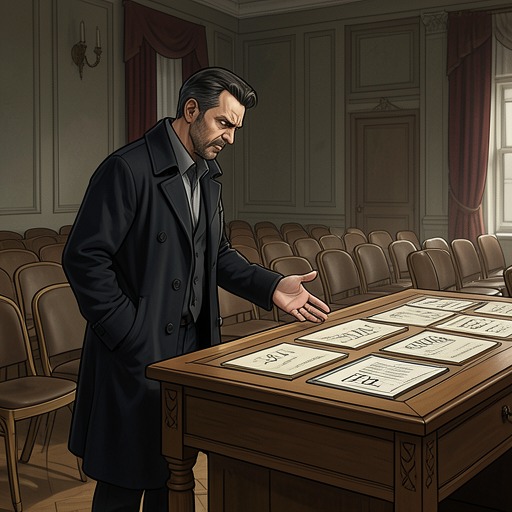
Luo Ji is introduced as an astronomer and sociologist rather than as a conventional military commander or engineer. His intellectual territory is the relationship between knowledge and civilization: he is asked to imagine a universe containing vast numbers of civilizations, perhaps on the order of the number of detectable stars, and to study the nature of that cosmic supersociety. The proposal initially sounds like a name chosen at random, especially because humanity knows only one civilization, but it gives Luo Ji the conceptual field in which the central problem of contact can be examined.
His introduction is framed by images of small life moving through upheaved ground and by the distant presence of the stars. The ant crosses a black formation created amid repeated geological catastrophe, while Luo Ji’s conversation turns toward the structure of cosmic civilization. The juxtaposition places his human reasoning inside a much larger process: individual minds search for purpose within turbulence, just as civilizations search for rules in an apparently purposeless universe. The narrative thereby establishes him as both a participant in history and an observer trying to infer its hidden laws.
The Fourth Wallfacer
Luo Ji is publicly designated the Fourth Wallfacer by Say. The appointment is not a voluntary commission that he can simply accept or refuse. The Wallfacer Project arises because Sophons make Earth completely transparent to the Trisolarans: meetings, files, computer memories, military details, and every openly communicated plan can be observed as soon as it takes shape. Humanity therefore needs a strategy whose essential operations remain inside a single person’s mind.
The Wallfacer system gives Luo Ji a peculiar form of power. Once appointed, he is separated from ordinary people by an invisible screen, and every action becomes potentially meaningful. The public cannot know whether he has begun work, whether an apparently trivial act conceals a plan, or whether an unremarkable expression is itself strategic. The result is the famous Wallfacer smile, a reaction that turns his entire visible life into an object of interpretation. Luo Ji understands that the mission is a cold and inescapable curse: he cannot abandon it, because the project’s logic has already made him significant.
This condition distinguishes Luo Ji from the mainstream defense program. The ordinary program is exposed to the enemy, while the Wallfacer Project depends on secret plans proceeding in parallel to it. The Trisolarans possess overwhelming informational access, but their direct mode of communication leaves them deficient in tricks, camouflage, and deception. Luo Ji’s value therefore rests not on matching their technology but on preserving a human advantage they cannot fully read: the ability to conceal intention behind action.
From Cosmic Sociology to the Dark Forest
Luo Ji’s central intellectual achievement is the formulation of a universe in which contact between civilizations is governed by survival rather than trust. He distinguishes benevolence from malice in strict terms: benevolence means not taking the initiative to attack and eradicate another civilization, while malice means the opposite. This narrow definition strips moral language down to behavior that can be evaluated across enormous distances and delays.
His reasoning leads to the image of the universe as a dark forest. Every civilization is imagined as an armed hunter moving silently among other hidden hunters. Because no civilization can safely know another’s intentions, capabilities, or future development, discovering another life-form creates a lethal dilemma. The other civilization may be benevolent, weak, young, or advanced, but allowing it to remain might expose the discoverer to future destruction. In this model, the rational response is to eliminate the other before the other can eliminate the observer.
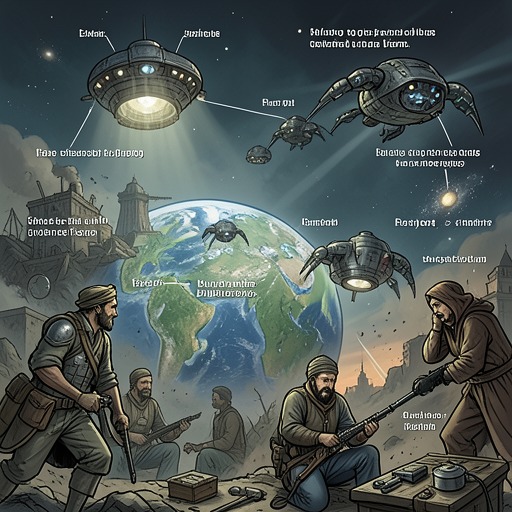
Humanity becomes the foolish child who has built a bonfire and repeatedly announces its presence. The metaphor explains why cosmic visibility is dangerous: communication does not necessarily create understanding, and a signal can function as a target marker. Luo Ji’s insight thus converts the information problem surrounding Sophons into a theory of civilization. The universe is not merely unknown; it is structured by incomplete knowledge, fear, and the inability to make a promise of peace credible across interstellar distances.
Strategy, Threat, and Survival
The later architecture of Luo Ji’s strategy depends on a dead-man’s mechanism. Earlier, Wallfacer Rey Diaz’s cradle system is defined by a continuous non-detonation signal sent to Mercury: the system remains safe only while the signal continues, and interruption causes the hydrogen bomb to detonate. Luo Ji adapts this logic on a far larger strategic scale. His own vital signs become the condition that prevents the Snow Project’s bombs from firing.
In the final confrontation, Luo Ji addresses Trisolaris directly at dawn and displays a watch-sized vital-sign monitor. The device is linked through a transmitter to a cradle system governing 3,614 bombs deployed in solar orbit. A signal is sent every second to keep them in a non-triggered state. If Luo Ji dies, the maintenance signal disappears, and the bombs detonate, converting the oil film around them into 3,614 clouds of interstellar dust that ring the sun.
The threat is not limited to physical destruction. The dust clouds would make the sun’s visible light and other high-frequency bands flicker. The bombs have been arranged so that this flickering forms three images made from thirty points, with one point marked in each image. Together, the images transmit the position of Trisolaris relative to twenty-nine surrounding stars. The sun would become a galactic lighthouse, broadcasting Trisolaris’s location while also exposing the position of the sun and Earth. Receiving the complete transmission from one point in the galaxy could take more than a year, but civilizations observing the sun from multiple positions might reconstruct it within days or hours.
Luo Ji’s leverage therefore rests on credibility. His strategy does not require humanity to defeat the Trisolaran Fleet in a conventional battle. It makes his continued life the restraint on an irreversible signal, turning assassination into a potentially self-destructive act. The same transparency that leaves Earth vulnerable becomes the basis for a threat: once the signal is released, the surrounding galaxy may learn where both civilizations are.
Change, Consequences, and Narrative Role
Luo Ji’s development moves from detached intellectual speculation to embodied responsibility. He begins by being invited to study a subject that sounds almost playful, a cosmic sociology invented to name an immense hypothetical society. As Wallfacer, he learns that even inaction can be interpreted as action and that the world will impose significance on everything he does. By the final showdown, that abstract condition has become literal: his body is wired into a system whose failure can transform his death into an interstellar broadcast.
His personal survival is consequently inseparable from the survival of Earth. The final scene places him before Ye Wenjie’s gravestone, speaking to Trisolaris while the dawn gradually extinguishes the stars. The surrounding world appears peaceful and unawakened, yet Earth has become a chip on a cosmic gambling table. The ant continues climbing through the maze of Ye Wenjie’s name, indifferent to the confrontation but still materially implicated in the world at stake. Luo Ji’s action is thus framed against both deep time and ordinary life: a human decision reaches across centuries, while a tiny creature remains part of the threatened planet.
The larger historical consequences surrounding Luo Ji’s strategy are severe. The annihilation of the combined fleet revives Escapism after two centuries of silence, and the Battle of Darkness shows how severing spiritual bonds with Earth can produce alienation so complete that the survivors seem to constitute a Negacivilization. In this altered political landscape, the former great powers decline while the space fleet rises as a suprastate entity. Luo Ji’s significance belongs to this historical transformation: he is not simply a clever individual confronting an enemy, but a figure through whom Earth’s political, military, and moral order is forced to recognize the scale of cosmic danger.
Luo Ji’s narrative role is therefore paradoxical. His greatest weapon is not technological superiority, open command, or public inspiration, but the preservation of an unknowable intention under conditions of total surveillance. He turns sociology into strategy, fear into deterrence, and mortality into a signal. The final image leaves the result suspended between salvation and catastrophe: the world does not yet know what Luo Ji has set in motion, but the possibility of civilization now depends on whether the dark forest remains silent or hears the light from Earth.